FAQs
Some of our natural gas network is made out of steel. To be able to disconnect your service from the steel network, we require specialised equipment and personnel.
Electricity and gas easements are important because they benefit both Vector and landowners by:
- Protecting a landowner’s safety by formally recording the location of the gas and/or electricity reticulation equipment on their property title.
- Providing us with legal rights to access your property so that we can operate, maintain or replace our equipment.
Easements are required over installed Vector owned gas and electricity equipment to allow those assets to remain on private property and to provide us with ongoing access rights.
Vector owned equipment means equipment installed by us as part of our work supplying customers with electricity or gas. This can include pits, poles, lines, cables, fuses and transformers, gas pipes, gas measurement systems, distribution systems and fittings, and other associated equipment.
Private property means real property that is privately owned and includes privately and jointly owned access roads in subdivisions, Council local purpose reserve or recreation land and Crown land.
Equipment installed on private property before 1 January 1993
For electricity and gas equipment installed on private property prior to 1 January 1993, we have existing use rights (which is a statutory right contained in the Electricity Act 1992) and will not usually require an easement unless we need to install new equipment or relocate existing equipment.
If new equipment is to be installed, we will require an easement over all new equipment together with any existing equipment as it may no longer be protected under the pre-existing statutory use rights.
We will let you know when an easement is required, and whether this is for new or existing electricity equipment. Where an easement is required, the obligation to grant an easement will form part of your contract with us to undertake the works.
We have standard easement terms which grant us necessary rights to access your property to inspect, operate and maintain our equipment. These must remain standard and unamended, for all properties throughout Auckland, so that our contractors and maintenance team can rely on them.
To register an easement, following installation of equipment, either we or the customer will organise a survey plan (depending on our contract together) which shows the area that will be granted to Vector for our easement. A legal document called the ‘easement instrument’ is then prepared by our legal team and sent to your solicitor. The registration of the easement on your property title will be processed by us together with your lawyer.
Vector owns the gas service pipe up to and including the gas riser (pipe going to the gas meter). The meter company owns the gas meter. You will own all outlet pipes from the gas meter to the appliances.
No.
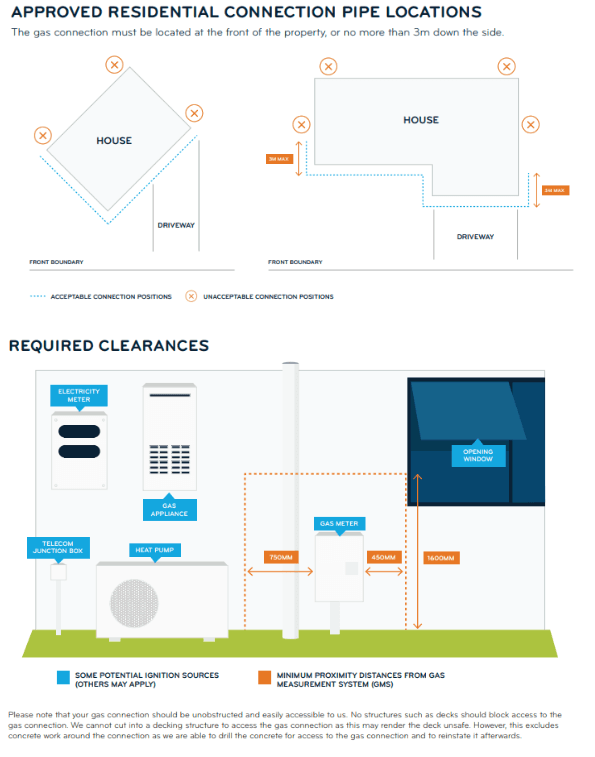
Residential gas connections must be installed in certain areas and must have clearances away from sources of ignition such as electricity meters and meter boxes as well as building openings such as doors, windows and flue terminals. For further information regarding approved pipe locations and meter clearances refer to the drawings below or talk to your energy retailer.
Commercial gas connections are generally placed on the boundary of the site. For safety reasons all public areas such schools, hospitals and parks will require a gas connection to be placed on a concrete pad and within a cage. If there is a lot of vehicle traffic, an additional barrier may also be required. Your energy retailer will be notified by the meter owner if a concrete pad and cage is required and they can also provide any further information regarding meter positions and clearances.